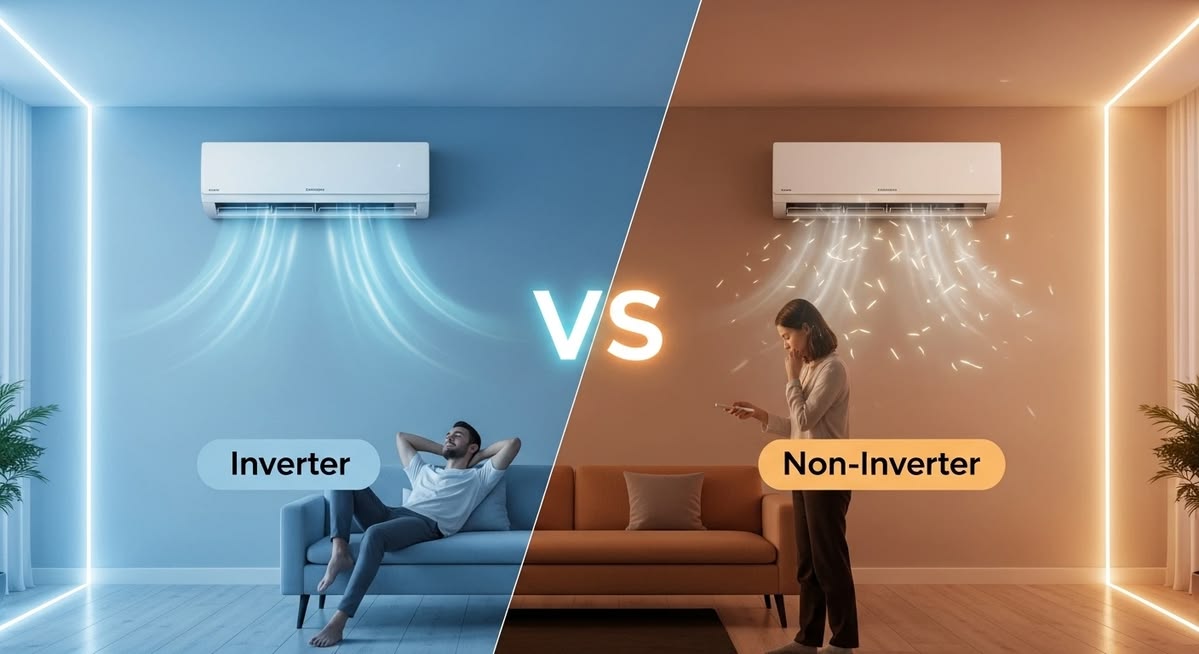
When shopping for a new air conditioner, one of the biggest decisions you’ll face is whether to choose an Inverter AC or a Non-Inverter AC. At first glance, both seem to do the same job—cooling your room. However, the technology behind them is quite different, and that difference can significantly impact your electricity bill, comfort level, and long-term savings.
Many buyers are tempted to choose a Non-Inverter AC because of its lower price. But is saving money upfront always the better choice? Let’s compare both options in detail.
What Is an Inverter AC?
An Inverter AC uses advanced compressor technology that can adjust its speed according to the room’s cooling requirement.
Instead of turning ON and OFF repeatedly, the compressor continuously operates at different speeds.
This helps:
- Maintain a consistent temperature
- Reduce power consumption
- Improve cooling efficiency
- Increase compressor lifespan
What Is a Non-Inverter AC?
A Non-Inverter AC uses a fixed-speed compressor.
It works in a simple cycle:
- Compressor starts at full power.
- Room reaches the desired temperature.
- Compressor shuts off.
- Temperature rises again.
- Compressor restarts at full power.
This repeated ON/OFF cycle consumes more electricity.
Inverter AC vs Non-Inverter AC: Quick Comparison
| Feature | Inverter AC | Non-Inverter AC |
|---|---|---|
| Electricity Consumption | Low | Higher |
| Cooling Comfort | Excellent | Good |
| Compressor Operation | Variable Speed | Fixed Speed |
| Noise Level | Lower | Higher |
| Initial Cost | Higher | Lower |
| Long-Term Savings | Better | Limited |
| Lifespan | Longer | Shorter |
| Energy Efficiency | Excellent | Average |
| Maintenance Cost | Moderate | Moderate |
| Best For | Daily Use | Occasional Use |
How Does Cooling Performance Differ?
Inverter AC
Inverter technology continuously adjusts cooling output.
Benefits:
✔ Stable room temperature
✔ No sudden temperature fluctuations
✔ Better comfort during long use
✔ Faster cooling response
The room feels more comfortable because the temperature remains consistent.
Non-Inverter AC
Since the compressor repeatedly starts and stops:
- Temperature fluctuates more often.
- Cooling may feel less consistent.
- The room alternates between cooler and slightly warmer periods.
Cooling Performance Winner
🏆 Inverter AC
Provides smoother and more comfortable cooling.
Electricity Bill Comparison
Electricity consumption is often the biggest deciding factor.
Inverter AC
Because the compressor adjusts its speed rather than stopping completely:
✔ Lower power usage
✔ Better efficiency
✔ Reduced monthly electricity bills
Especially beneficial for users who run the AC for many hours daily.
Non-Inverter AC
Every time the compressor restarts, it consumes additional energy.
As a result:
- Higher electricity usage
- Increased monthly bills
- Less efficient operation
Electricity Savings Winner
🏆 Inverter AC
Can significantly reduce long-term electricity expenses.
Noise Level Comparison
Inverter AC
The compressor runs at varying speeds.
Benefits:
- Smoother operation
- Less vibration
- Quieter performance
Ideal for:
- Bedrooms
- Home offices
- Study rooms
Non-Inverter AC
The compressor frequently starts and stops.
This can create:
- More noise
- More vibration
- Less comfortable sleeping conditions
Noise Winner
🏆 Inverter AC
Noticeably quieter.
Initial Purchase Cost
Inverter AC
Advanced technology increases manufacturing costs.
Therefore:
- Higher purchase price
- Larger upfront investment
Non-Inverter AC
Traditional technology keeps costs lower.
Benefits:
✔ Affordable
✔ Lower initial investment
✔ Suitable for budget buyers
Price Winner
🏆 Non-Inverter AC
Cheaper to buy initially.
Long-Term Cost Comparison
Many buyers focus only on the purchase price.
However, long-term costs tell a different story.
Example Scenario
Suppose:
- AC runs 8–10 hours daily during summer.
- Electricity rates continue increasing.
Over several years:
- An Inverter AC may save substantial electricity costs.
- The savings can often offset the higher purchase price.
Who Should Buy an Inverter AC?
An Inverter AC is ideal if:
✔ You use the AC regularly.
✔ You run it for several hours every day.
✔ You want lower electricity bills.
✔ You prioritize comfort and quiet operation.
✔ You’re planning long-term usage.
Who Should Buy a Non-Inverter AC?
A Non-Inverter AC may be suitable if:
✔ Your budget is limited.
✔ You use the AC occasionally.
✔ The room is used infrequently.
✔ You want the lowest initial investment.
Maintenance Comparison
Many people assume Inverter ACs are difficult to maintain.
In reality:
- Both AC types require regular servicing.
- Filter cleaning is necessary in both.
- Professional servicing is recommended annually.
The maintenance difference is usually not significant.
Maintenance Winner
🤝 Tie
Proper servicing matters more than the technology type.
Which AC Offers Better Value?
| Category | Winner |
|---|---|
| Cooling Comfort | Inverter AC |
| Electricity Savings | Inverter AC |
| Noise Reduction | Inverter AC |
| Long-Term Value | Inverter AC |
| Initial Cost | Non-Inverter AC |
| Budget Friendly | Non-Inverter AC |
Is the Extra Cost Really Worth It?
For most households, the answer is yes.
While Inverter ACs cost more initially, they often provide:
- Better cooling comfort
- Lower electricity bills
- Quieter operation
- Greater efficiency
If you use your AC regularly, the long-term savings can make the additional investment worthwhile.
However, if you only use the AC occasionally, a Non-Inverter AC may still be a practical and cost-effective choice.
The best option ultimately depends on your budget, usage habits, and long-term expectations.
Choosing the Right AC for Your Home
An air conditioner is a long-term investment. Looking beyond the purchase price and considering energy savings, comfort, and reliability can help you make a smarter decision.
For most modern homes, an Inverter AC offers the best balance of performance and efficiency, while a Non-Inverter AC remains a good option for occasional use and tighter budgets.
Understanding your needs before buying ensures you get the maximum value from your investment.