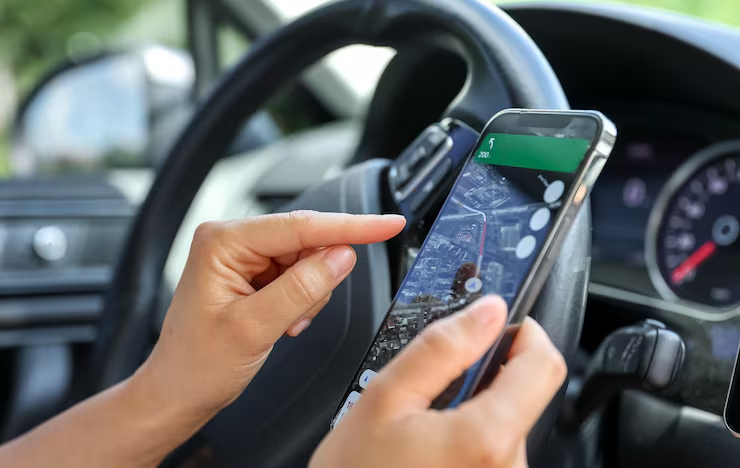
Imagine you’re driving to a place you’ve never visited before.
A navigation app tells you to turn left.
But your instincts say the road doesn’t look right.
What do most people do?
They follow the GPS.
In fact, many people trust GPS directions even when something feels wrong.
This isn’t because people suddenly forgot how to navigate. It’s because digital navigation has become incredibly reliable and deeply integrated into daily life.
Today, millions of people use GPS every day without giving much thought to how dramatically it has changed human behavior.
Let’s explore why GPS became one of the most trusted technologies in modern life.
Life Before GPS Was Very Different
Younger generations may find it hard to imagine, but navigation wasn’t always easy.
People relied on:
- Paper maps
- Road signs
- Local directions
- Memory
- Landmarks
Getting lost was common.
Long trips required planning.
Unexpected road closures could create major problems.
Traveling to unfamiliar places often involved uncertainty.
Today, a smartphone can provide turn-by-turn directions within seconds.
GPS Removes Uncertainty
One reason people trust GPS so much is that it reduces uncertainty.
Humans generally prefer certainty.
When a navigation app shows:
- The route
- Distance
- Travel time
- Traffic conditions
people feel more confident.
Even if they don’t know the area, they feel guided.
This psychological comfort plays a huge role in GPS adoption.
Technology Has Earned Our Trust
GPS didn’t become popular overnight.
People learned through experience that it usually works.
Every successful trip reinforces confidence.
If a navigation app correctly guides someone dozens of times, they naturally begin trusting it more.
Over time, GPS becomes the default source of direction.
Real-Time Traffic Data Changed Everything
Traditional maps couldn’t tell users:
- Traffic conditions
- Accidents
- Road closures
- Construction zones
Modern navigation systems can.
This ability makes GPS significantly more useful than memory or static maps.
Users know they’re receiving information that changes in real time.
The Convenience Factor
Convenience influences many technology choices.
GPS allows users to:
- Find locations instantly
- Avoid asking for directions
- Discover alternate routes
- Estimate arrival times
The ease of use makes navigation almost effortless.
As a result, people become increasingly dependent on it.
Are We Losing Our Natural Navigation Skills?
Some researchers believe heavy GPS usage may reduce certain navigation skills.
When people rely entirely on digital directions, they may pay less attention to:
- Street names
- Landmarks
- Route planning
This doesn’t mean GPS is harmful.
However, it highlights how technology can influence human habits.
When GPS Gets Things Wrong
Although GPS is impressive, it isn’t perfect.
Occasionally it may:
- Suggest inefficient routes
- Use outdated road information
- Lose signal
- Misinterpret locations
Most users have experienced at least one strange GPS recommendation.
This reminds us that technology should assist decision-making, not completely replace common sense.
How GPS Changed Modern Industries
GPS doesn’t only help drivers.
Entire industries depend on it.
Examples include:
Delivery Services
Packages arrive more efficiently.
Ride-Sharing Platforms
Drivers locate passengers quickly.
Logistics Companies
Routes become more optimized.
Emergency Services
Response times improve.
GPS influences far more than personal travel.
The Future of Navigation
Future navigation systems may become even smarter.
Potential improvements include:
- Augmented reality directions
- AI-assisted route planning
- Better traffic prediction
- Enhanced indoor navigation
As technology evolves, navigation will likely become even more seamless.
Conclusion
People trust GPS because it consistently provides accurate, convenient, and real-time guidance.
Over the years, successful experiences have built confidence in digital navigation systems.
While it’s still valuable to maintain awareness of our surroundings, GPS has undoubtedly become one of the most trusted technologies of the modern era.
The next time you automatically follow your navigation app, remember that you’re participating in one of the biggest behavioral shifts technology has created in recent decades.