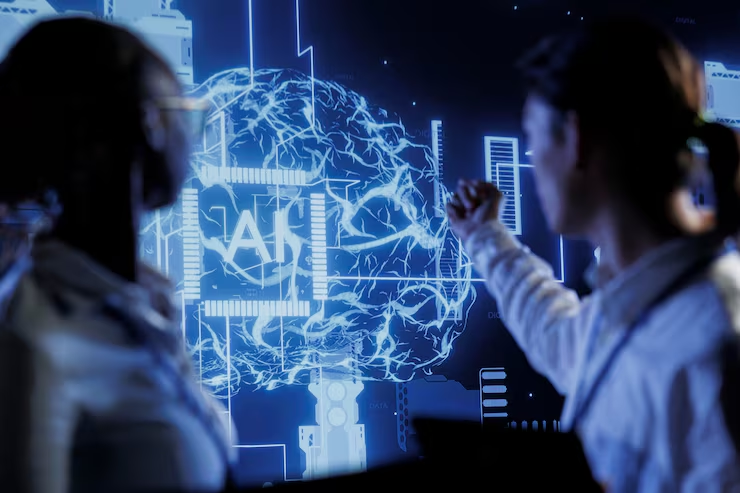
When most people think about technology, they picture things like smartphones, laptops, smartwatches, or Artificial Intelligence.
These are the technologies we can see.
They are visible.
We interact with them directly every day.
But some of the most important technologies in modern life operate quietly in the background.
We rarely think about them.
We don’t notice them.
In fact, many people don’t even realize they are using them.
Yet if these hidden technologies suddenly disappeared, everyday life would become much more difficult almost instantly.
From the moment you wake up in the morning until you go to sleep at night, dozens of technologies work behind the scenes to make life faster, easier, and more convenient.
Let’s take a closer look at some of the hidden technologies that have become such a normal part of life that most people barely notice them anymore.
Technology Is Most Powerful When It Becomes Invisible
A fascinating thing happens when a technology becomes successful.
At first, everyone talks about it.
People are excited.
News articles cover it.
Companies advertise it.
But over time, the technology becomes so common that people stop paying attention to it.
Think about electricity.
Nobody wakes up every morning amazed that lights turn on when a switch is pressed.
It has become normal.
The same thing has happened with many digital technologies.
They work so smoothly that people barely notice them anymore.
GPS Navigation
Imagine traveling to a city you’ve never visited before.
Twenty years ago you might have carried a paper map or asked strangers for directions.
Today most people simply open a navigation app.
Within seconds they know:
- Where they are
- Where they need to go
- Which route is fastest
- How long the journey will take
GPS technology has completely transformed navigation.
Yet because it works so well, many people rarely stop to think about how remarkable it actually is.
Millions of delivery drivers, taxi drivers, travelers, and commuters depend on GPS every day.
Without it, transportation systems would be significantly less efficient.
Spam Filters Protect Your Inbox
Most people receive very few spam emails today compared to the early days of the internet.
This isn’t because spammers stopped sending messages.
In fact, spam still exists in enormous quantities.
The difference is that modern spam filters work constantly behind the scenes.
Every day they analyze:
- Suspicious messages
- Fraud attempts
- Unwanted promotions
- Potential phishing emails
Many users never even see these messages because filtering systems block them automatically.
Without spam filters, inboxes would become nearly unusable.
Cloud Storage
Cloud storage is another technology that quietly transformed daily life.
Years ago people worried about losing files if a computer crashed.
Today documents, photos, and videos are often backed up automatically.
Many users take thousands of photos every year without thinking about storage management.
Cloud platforms help keep those files accessible across multiple devices.
The convenience feels normal now, but it represents a major technological achievement.
Online Payment Systems
Imagine standing in a store.
You tap your phone.
The payment is completed in seconds.
Simple.
Fast.
Convenient.
Behind that simple transaction is a complex system involving:
- Banks
- Payment processors
- Security verification
- Data encryption
- Communication networks
The process happens so quickly that most people never think about it.
Yet digital payments have fundamentally changed commerce around the world.
Autocorrect and Predictive Text
Typing on smartphones would be far more frustrating without autocorrect.
Modern keyboards constantly analyze what users type.
They predict words.
Correct spelling mistakes.
Suggest phrases.
Help complete sentences.
Because these features work automatically, many users hardly notice them anymore.
Yet they save enormous amounts of time every day.
Search Engines
Think about how often you search for information.
Questions.
Directions.
Recipes.
Tutorials.
Product reviews.
Search engines have become one of humanity’s most frequently used tools.
They provide access to information within seconds.
Previous generations often relied on libraries, books, or experts to find answers.
Today information is available almost instantly.
Content Recommendation Systems
When you watch videos online or browse social media, recommendation systems help determine what you see.
These systems analyze patterns and suggest content that may be relevant.
Examples include:
- Video recommendations
- Product suggestions
- News feeds
- Music recommendations
Many users interact with these systems every day without realizing how much technology is involved.
Two-Factor Authentication
Security technologies often receive attention only when something goes wrong.
Two-factor authentication quietly protects millions of online accounts.
When users receive verification codes during login, additional security checks are taking place behind the scenes.
These systems help reduce unauthorized access and improve online safety.
Website Caching
Have you ever wondered why frequently visited websites load so quickly?
One reason is caching.
Caching temporarily stores data so it can be delivered faster during future visits.
Most users never think about caching, yet it significantly improves browsing speed.
Without it, many websites would feel noticeably slower.
Background Software Updates
Many devices update automatically.
Security patches.
Bug fixes.
Performance improvements.
Compatibility updates.
These processes often happen with minimal user involvement.
As a result, devices continue improving over time without requiring extensive technical knowledge.
Most people only notice updates when a notification appears.
Digital Maps Beyond Navigation
Digital maps do much more than provide directions.
They help users:
- Find businesses
- Check traffic conditions
- Locate services
- Explore new areas
Many businesses depend on digital maps for visibility and customer discovery.
The impact extends far beyond personal navigation.
The Internet Infrastructure Nobody Sees
When people think about the internet, they usually think about websites and apps.
What they don’t see are the systems that make connectivity possible.
These include:
- Data centers
- Fiber optic networks
- Servers
- Routing systems
- Communication infrastructure
Without these technologies, modern internet services simply wouldn’t exist.
Artificial Intelligence in Everyday Life
Many people associate AI with chatbots and image generation.
However, AI already operates behind the scenes in countless ways.
Examples include:
- Spam detection
- Translation tools
- Voice assistants
- Search results
- Fraud prevention systems
Often users interact with AI without even realizing it.
Why We Stop Noticing Technology
Humans adapt quickly.
Once a technology becomes reliable, it fades into the background.
People stop focusing on the technology itself and focus instead on the benefits it provides.
This is why some of the most influential technologies are also the least visible.
Their success comes from becoming part of everyday life.
What Would Happen If These Technologies Disappeared?
Imagine losing access to:
- GPS
- Online payments
- Cloud storage
- Search engines
- Spam filters
Daily activities would become far more complicated.
Tasks that currently take seconds might require significantly more effort.
This thought experiment reveals just how dependent modern society has become on hidden technology.
The Future of Invisible Technology
Technology will likely become even less visible in the future.
Artificial Intelligence, smart devices, automation, and connected systems are expected to integrate more deeply into everyday life.
Future technologies may work quietly in the background without requiring direct interaction.
The trend is clear:
The more successful a technology becomes, the less noticeable it often appears.
Conclusion
When people think about technology, they usually focus on devices they can see and touch.
Yet many of the technologies that have had the greatest impact on society operate silently behind the scenes.
GPS navigation, cloud storage, spam filters, online payments, search engines, security systems, and recommendation algorithms all help power modern life.
Most of us use these technologies every single day without giving them much thought.
Their greatest achievement isn’t just what they do.
It’s that they’ve become so reliable and so deeply integrated into daily routines that we barely notice they’re there at all.